


The Australian Government's Support at Home program helps older Australians receive personalised care and support while continuing to live safely and independently in their own homes. If you or a loved one needs assistance with everyday tasks, personal care, nursing, or allied health services, understanding how to access the program is the first step.
This guide explains who is eligible, how the application process works, and practical tips to help you access Support at Home with confidence.
What Is the Support at Home Program?
Support at Home is the Australian Government's primary in-home aged care program, replacing the former Home Care Packages (HCP) Program and Short-Term Restorative Care (STRC), while progressively incorporating the Commonwealth Home Support Programme (CHSP).
The program is designed to provide personalised support that helps older Australians remain independent at home for longer. Depending on your assessed needs, funding may cover a range of services, including:
- Personal care
- Domestic assistance
- Meal preparation
- Transport
- Nursing care
- Allied health services
- Social support
- Assistive technology
- Home modifications
Support at Home delivers funding based on your individual care needs, ensuring you receive the right level of support as your circumstances change.
Who Is Eligible?
You may be eligible for the Support at Home program if you:
- Are 65 years or older (or 50 years or older for Aboriginal and Torres Strait Islander people).
- Need support to continue living safely and independently at home.
- Complete an aged care assessment through the Australian Government's Single Assessment System.
- Are assessed as requiring government-funded aged care services.
In some cases, younger people with age-related care needs may also be eligible.
Step-by-Step Guide to Applying
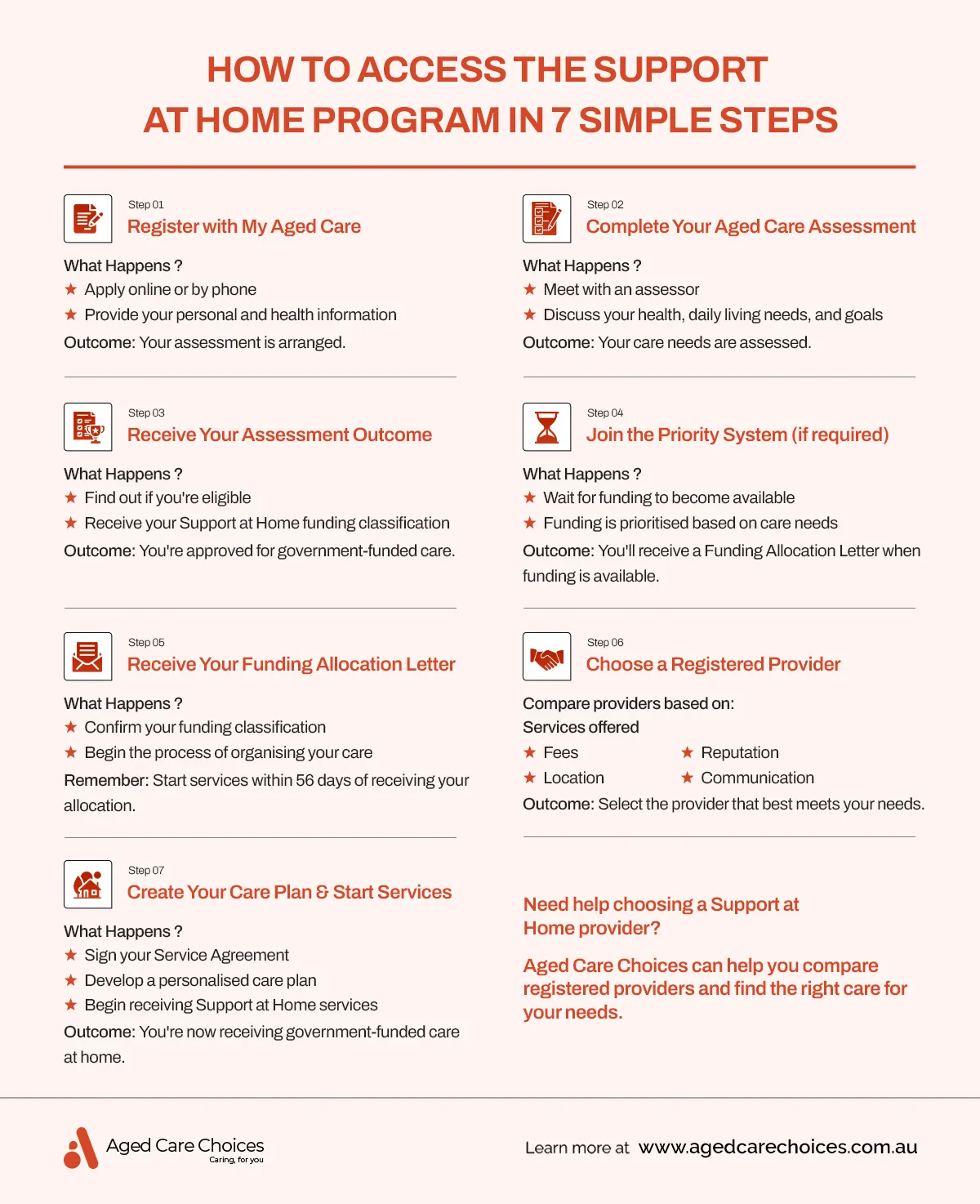
Although many people refer to it as "applying" for Support at Home, the process actually begins by accessing aged care services through My Aged Care.
Step 1: Register with My Aged Care
The first step is to register with My Aged Care, the Australian Government's entry point for aged care services.
You can register:
- Online
- By calling My Aged Care
- With assistance from your GP, family member, carer, or authorised representative
During registration, you'll be asked about:
- Your health
- Daily living activities
- Current support arrangements
- Personal details
- Contact information
Step 2: Complete an Aged Care Assessment
After registering, My Aged Care will arrange an assessment through the Single Assessment System.
An assessor will discuss:
- Your overall health
- Mobility and physical function
- Daily living activities
- Home environment
- Current supports
- Personal goals and preferences
The assessment is usually completed in your home, allowing the assessor to better understand your individual circumstances and recommend appropriate services.
Step 3: Receive Your Assessment Outcome
After your assessment, you'll receive a decision outlining:
- Whether you're eligible for government-funded aged care
- Your recommended Support at Home funding classification
- Any short-term support pathways you may be eligible for
- Recommended services based on your assessed needs
If approved, you'll also receive information explaining the next steps.
Step 4: Join the Support at Home Priority System
Approval does not always mean funding is immediately available.
If ongoing Support at Home funding isn't available straight away, you'll join the Support at Home Priority System while waiting for funding to be allocated.
Funding is prioritised according to:
- Your assessed care needs
- Clinical urgency
- The date you were approved
If your needs change while waiting, you can request a reassessment through My Aged Care.
Step 5: Receive Your Funding Allocation Letter
When funding becomes available, you'll receive a Funding Allocation Letter.
This letter confirms:
- Your funding classification
- When your funding starts
- Your next steps
- The timeframe for commencing services
After receiving your allocation, you'll generally need to enter into a Service Agreement and begin receiving services within 56 days. If you need more time, you may be able to request an extension through My Aged Care.
Step 6: Choose a Registered Support at Home Provider
Once you've received your funding allocation, you can choose a registered Support at Home provider.
When comparing providers, consider:
- Services offered
- Experience and reputation
- Availability in your area
- Fees and participant contributions
- Communication and responsiveness
- Care management approach
Choosing the right provider can make a significant difference to your overall experience and the quality of care you receive.
Step 7: Develop Your Care Plan and Sign a Service Agreement
Your chosen provider will work with you to develop a personalised care plan based on your assessed needs and personal goals.
Together, you'll discuss:
- The services you'll receive
- How often services will be delivered
- Your care goals
- Any participant contributions
- How your services will be reviewed
Before services begin, you'll sign a Service Agreement outlining the care to be provided, your responsibilities, fees, and other important information.
Following this process will help ensure that you or your loved one can enjoy a comfortable and confident aging experience at home, receiving the necessary support to maintain independence and quality of life.
Tips for a Smooth Application Process
Applying for Support at Home can be easier with a little preparation. Consider these tips before starting the process:
- Gather any relevant medical information and health records before your assessment.
- Make a list of the daily activities you find difficult and the support you currently receive.
- Think about both your current and future care needs so your assessment reflects your long-term goals.
- Ask a family member, friend, or carer to attend your assessment if you'd like additional support.
- Prepare questions about the services available and what to expect after approval.
- Compare registered Support at Home providers to find one that offers the services and support that best match your needs.
Being prepared can help ensure your assessment accurately reflects your circumstances and makes the transition to receiving care much smoother.
Conclusion
The Support at Home program makes it possible for eligible older Australians to continue living independently while receiving the care and services they need. Although the process involves several steps - from registering with My Aged Care and completing an assessment to receiving funding and choosing a provider - understanding how it works can make the journey much less overwhelming.
If you're ready to explore your options, Aged Care Choices can help you compare registered Support at Home providers, understand the services available, and make an informed decision with confidence.
Frequently Asked Questions (FAQs)
1. How do I apply for the Support at Home program?
To access the Support at Home program, you'll first need to register with My Aged Care online or by phone. After registering, you'll complete an aged care assessment through the Single Assessment System to determine your eligibility and support needs.
2. Who is eligible for Support at Home?
Generally, you may be eligible if you are aged 65 years or older (or 50 years or older for Aboriginal and Torres Strait Islander people), need assistance to continue living independently at home, and are assessed as eligible through the Single Assessment System.
3. Do I need an ACAT assessment for Support at Home?
The previous ACAT assessment process has been replaced by the Single Assessment System. A qualified assessor will evaluate your health, daily living needs, mobility, home environment, and personal goals to determine your eligibility and funding classification.
4. How long does it take to get approved for Support at Home?
The timeframe varies depending on your individual circumstances, assessment priority, and funding availability. After your assessment, you may receive immediate approval or be placed on the Support at Home Priority System until funding becomes available.
5. What happens after I'm approved?
If you're approved, you'll receive your assessment outcome and, once funding becomes available, a Funding Allocation Letter. You can then choose a registered Support at Home provider, develop a personalised care plan, sign a Service Agreement, and begin receiving services.
6. Can I choose my own Support at Home provider?
Yes. Once you've received your funding allocation, you can choose any registered Support at Home provider that services your area. Comparing providers can help you find one that best suits your care needs, preferences, and budget.


